

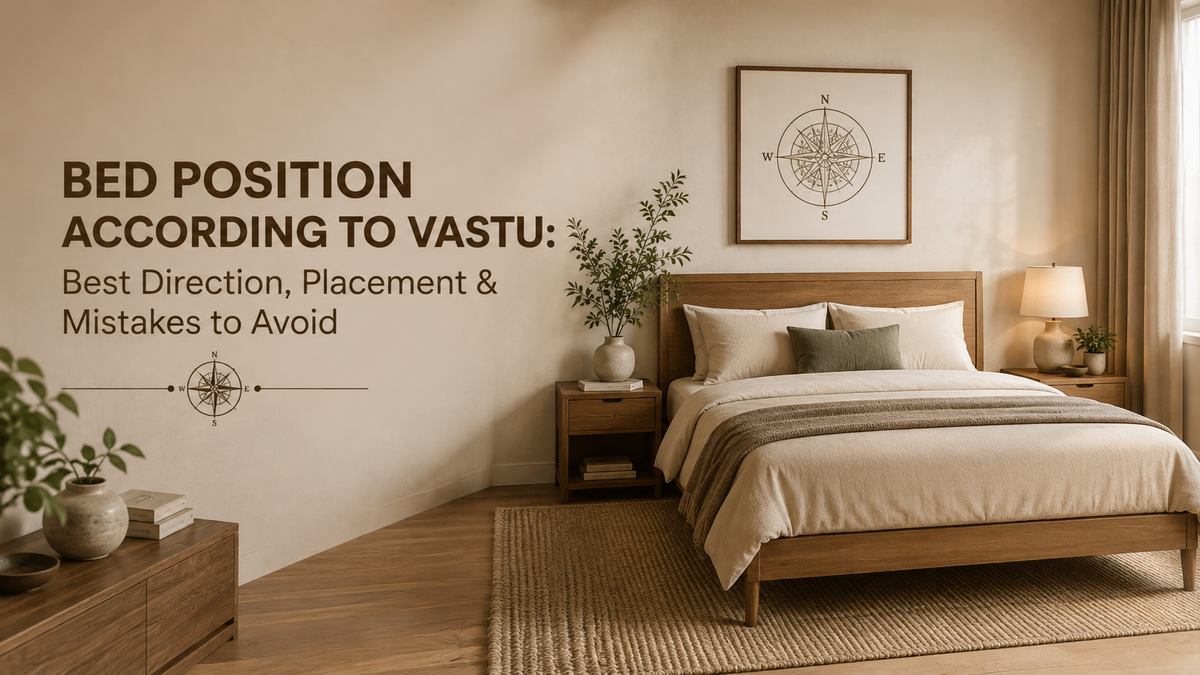
Quick Read: Vastu says the best bed position is the south-west part of the room, with your head towards the south (east and west are acceptable) and the headboard against a solid wall. Avoid sleeping with your head towards the north, and avoid placing the bed under a beam, directly under a window or in a straight line with the door. Keep mirrors away from the bed and the space below it clear. If your room cannot follow the ideal layout, small fixes like moving the bed a few feet, closing a curtain or covering a mirror at night help. This guide also gives an honest note on what science does and does not say.
Quick Guide: Bed Position as per Vastu
The ideal bed position as per Vastu is the south-west part of the room, with your head towards the south (or east) and the headboard against a solid wall. Keep the north-east corner for anything but your bed. The table below puts every rule in one place.
| Element | Best | Acceptable | Avoid |
|---|---|---|---|
| Head direction | South | East, West | North |
| Bed position in room | South-west | South, West | North-east |
| Headboard | Solid wall | None | Window, door side |
| Other conditions | Door visible, no mirror, no beam above | None | Straight line with door |
What Is the Best Bed Position According to Vastu?
The best bed position according to Vastu is the south-west corner of the bedroom, with the head towards the south and the headboard resting on a solid wall. In Vastu Shastra, the south-west zone is linked with stability, weight and rest, which is exactly what a bed is supposed to deliver. Followers of bed position as per Vastu also like the bed to sit slightly away from the corner walls, about a hand's width, so air can move around the frame instead of sitting trapped behind it.
The logic is simple, even if you do not buy every part of it. Heavy furniture goes in the heavy zone, and the light, open zone stays free for movement and light. Think of it like packing a suitcase: the heavy stuff goes at the bottom and the delicate stuff goes on top. Your bed is the heaviest thing in the bedroom, so it belongs in the south-west, and the north-east can keep its breathing space.
Best Sleeping Direction According to Vastu
The best sleeping direction according to Vastu is south, followed by east, and then west as a backup. North is the one to skip. If you have ever wondered about the best direction to sleep, this is the short version, and the sections below explain why each direction earns its rank. Vastu's idea is that your head should point towards south or east, so your feet point away from the north.
Most Vastu advice describes the sleeping direction as a mix of tradition and magnetism. The south head position is said to bring deep sleep and good health, east is said to bring clarity, west is neutral to mildly positive, and north is blamed for restless nights. Treat these as the traditional claims, not lab results, and read the science section later in this guide before you start rearranging a rented flat.
South: The Best Direction to Sleep
South is the top pick in almost every Vastu text, which is why most master bedrooms are planned around a south head position. Sleeping with your head towards the south is said to support deep, undisturbed rest, steady energy and better health, and it is the direction most Indian homes follow without even thinking about it. If your bed can face this way, the rest of the rules become easier to follow.
Traditionally, the explanation is that the human body has its own north and south, with the head as one pole and the feet as the other. The head towards the south is said to line up with the earth's field the way two magnets line up, which is a pretty picture but not a proven one. Even so, south is the least risky choice if you want to follow Vastu closely.
East: Best for Students and Clarity
East is the direction of the rising sun, and Vastu connects it with learning, fresh starts and a clear head. Sleeping with your head to the east is the classic recommendation for students, and for anyone in a phase where focus and memory matter more than raw rest. Many families choose it for children's rooms for exactly this reason.
It also works well for anyone who wakes up in the morning facing a bright window, since you start the day looking at light instead of a wall. If your south wall is a door or a window, east is the practical alternative, and you lose very little by choosing it.
West: An Acceptable Alternative
West is not wrong, it is just a second tier. Vastu treats a west head position as acceptable, mostly neutral and sometimes helpful for people who want a calm, grounded sleep. It suits rooms where the south and east walls are taken up by doors, windows or built-in wardrobes.
Use it when south and east are not possible, and keep the other rules in place. A west head position with a solid headboard wall and a clear view of the door is far better than a south head position with a window right behind your pillow.
North: Why Vastu Says to Avoid It
Vastu advises against a north head position because it is said to bring disturbed sleep, tiredness and mental restlessness. The traditional reason is the magnetic one: the body's head pole and the earth's north pole are said to repel each other, like matching ends of two magnets. It also has a cultural side, since in many Indian traditions the head points north only after death.
If you are already sleeping with your head to the north, there is no need to panic. It is a traditional guideline, and the fixes in the section below make it much easier to live with. But if you are choosing a layout from scratch, simply pick a different wall.
Bed Direction as per Vastu for Different People
Bed direction as per Vastu changes slightly with age and role, because each person needs something different from their sleep. Couples need stability, students need clarity, kids need calm and elders need comfort and safety. A single home can follow different head directions in different rooms without breaking any rule, so do not try to force the whole house into one layout.
For Married Couples
For married couples, Vastu recommends the south-west bedroom with the head towards the south. The south-west is called the zone of stability and relationships, and it is the traditional home of the master bedroom. Many traditional sources add that the wife sleeps on the husband's left side, though that is a custom, not a rule everyone follows.
If your master bedroom sits in the north-west or south-east, do not rush to move house. Keep the head towards the south or west, use a solid headboard and keep mirrors out of the line of sight from the pillow, and you already follow most of the guidance.
For Students
For students, the east head position is the favourite, because it is linked with focus, memory and a fresh morning mind. Keep the study table in the east or north too, and keep books off the bed. A bed is for sleeping, and a desk is for studying, and mixing them is a good way to ruin both.
South works too if east is not possible. West is fine for an exam-heavy week when the room only allows that wall.
For Kids
For kids, the east or west head positions are the usual advice, and the north-west part of the house is considered good for children's rooms. Keep the bed away from sharp corners, avoid placing it under a beam or ceiling fan and keep a night lamp in the corner. Kids also grow fast, so a bed that has some room to move around it gives you room to adjust the layout later.
For Elders
For elders, Vastu suggests the south-west or west side of the house, with the head to the south or east. The south-west gives stability and the west gives calm, and both are said to suit slower, quieter routines. It makes practical sense too: a ground floor room near the bathroom reduces night-time stairs and long walks.
Keep a clear path from bed to bathroom, avoid rugs that curl up at the edges and keep the bed height comfortable for getting in and out. Vastu and common sense agree on this one.
For Guest Rooms
For guest rooms, the north-west is the traditional zone, because the north-west is linked with movement and visitors who stay for a while and then leave. The head can point south or west. A guest room does not need as much rule-following as a master bedroom, so you can relax a little here.
Keep the bed clean, the sheets fresh and a bedside lamp within reach, and the room does its job regardless of direction.
Bed Placement as per Vastu: Rules to Follow
Bed placement as per Vastu comes down to six simple rules that apply in any room, whichever way the bed faces. They are about protection, calm and clear space, and you will notice that most of them also make practical sense. Even if you only follow three of them, you will likely sleep better than before, simply because you have thought about the room.
Keep the Headboard Against a Solid Wall
Place the headboard against a solid wall, not a window, door or open space. Vastu says a solid wall behind the head gives a feeling of support and security, and psychologically that is easy to believe. Sleeping with your head against an open space or a window is said to cause restlessness, and it can also bring cold air and street noise right to your pillow.
If you cannot place the headboard against a solid wall, a sturdy, tall headboard acts as a stand-in. It is not a perfect fix, but it gives your head something solid behind it.
Position the Bed So You Can See the Door
Place the bed so you can see the door from where you lie, without being in a straight line with it. Vastu says that being able to see the door gives you a sense of control and safety, and that is a pretty well-known idea in other design traditions too. Being in a direct line with the door, though, is said to invite sudden energy and disturb sleep.
The best spot is diagonal to the door, so you can see it but are not directly facing it. It is the same logic as picking a restaurant table: a corner seat with a view of the entrance feels better than sitting with your back to the door.
Avoid Placing the Bed Under a Beam or Window
Avoid placing the bed under an exposed beam or directly under a window. A beam overhead is said to create pressure and stress, and it can cause headaches and a heavy feeling in the head. Practically, a beam above you also means less air and a lower ceiling feel.
A window directly behind the headboard breaks the solid wall rule and lets in light, noise and drafts. If you have no other choice, use heavy curtains and keep the window closed at night, and avoid sleeping right under the glass.
Keep Mirrors Away from the Bed
Keep mirrors out of the line of sight from the bed, especially anything that reflects you while you sleep. Vastu says that mirrors facing the bed double the energy in the room and cause restless sleep. There is also a plain human reason: waking up in the night and seeing a moving shape in the dark is a good way to wake up completely.
If you cannot move the mirror, cover it with a cloth at night or fit a wardrobe door that closes over it. A mirror on the inside of a wardrobe door is the easiest fix for most rooms.
Don't Share a Wall with the Bathroom
Avoid placing the headboard on a wall shared with the bathroom. Vastu says that water and drainage energy behind the head is not helpful for rest and health. It is also practical, since a wet wall behind the pillow means damp, noise from flushing and plumbing smells.
If the bed has to sit against that wall, put a thick wardrobe, a bookshelf or another buffer between them, or use a headboard that sits a little forward of the wall.
Keep the Space Under the Bed Clear
Keep the space under the bed clear and clean, because Vastu says clutter below your body creates restless energy. Old shoes, boxes and broken items are the worst offenders. Storing a few things is fine, and in a small flat it is often unavoidable, but keep it tidy and keep the items light, soft and useful, like bedding and spare linen.
Which Is the Best Bedroom Direction for the Bed?
The best bedroom direction for the master bedroom is the south-west part of the house, and inside that room, the bed goes in the south-west corner with the head to the south. Vastu calls the south-west the zone of weight, earth and stability, and that is why master bedrooms are traditionally planned there. The south and west are the backup options, while the north-east is the one to avoid for sleeping.
Inside the room, think in layers. First pick the bedroom zone, then place the bed in the south-west corner of that room, and then choose the head direction. The north-east corner of the bedroom is best kept light and open, perhaps with a plant, a lamp or just clear floor. A bed in the north-east is the one placement Vastu really frowns on, because it puts the heaviest object in the zone meant for lightness.
Bed Position Mistakes to Avoid According to Vastu
Most Vastu bed mistakes are easy to fix once you spot them. Here are the common ones, each with a one-line fix:
What If Your Bed Can't Face the Ideal Direction?
If your bed cannot face the ideal direction, follow the next best rule and keep the other placement rules in place. Most people live in rented flats or small rooms where the layout is fixed, and no one is going to knock down a wall for a bed. Pick the best of the options you have: south first, then east, then west, and only use north as the last resort.
For rented homes and small rooms, a few practical fixes help. Rotate the bed to a different wall, even if the room looks a bit odd at first, or swap the bed and the wardrobe if that gives you a better direction. If the head has to point north, use a solid headboard and a calm, clutter-free room and sleep with your feet towards the door. If the bed sits under a window, add heavy curtains and a taller headboard. Use a room divider or a bookshelf to separate the bed from the bathroom wall. And if a mirror cannot move, a simple cloth cover at night solves it in seconds. Vastu is meant to be a guide, not a source of stress, so do what the room allows and stop there.
How Do You Find the Right Direction in Your Bedroom?
Stand in the centre of the room, open a compass app on your phone and note which way south points. Hold the phone flat and away from metal objects, magnets and your speakers, because those can throw the reading off. Walk to each wall and see which one faces south, east, west and north, and mark them on a rough sketch if that helps.
Phone compasses are not always perfect, so calibrate yours by moving the phone in a figure-eight shape before you read it. A physical compass works as well, and a quick check from two or three spots in the room will confirm the answer. Magnetic north and true north differ slightly, but across most of India the gap is small enough that it will not change which wall counts as south.
Does Vastu Bed Direction Have Scientific Backing?
No, not in the way it is usually claimed. Vastu is a traditional system, and the popular explanation that sleeping with your head to the north harms you because of the Earth's magnetic field is not established science. Earth's magnetic field is real, but it is very weak, roughly 25 to 65 microtesla depending on where you are, and a normal fridge magnet is far stronger than that. Nothing solid shows that your body's iron or blood flow reacts to it while you sleep.
So if you are asking which direction to sleep scientifically, the honest answer is that sleep research does not name a best compass direction. What it does show is that sleep quality depends on things like a dark, quiet and cool room, a consistent schedule and avoiding bright screens before bed. Adults are advised to sleep at least seven hours a night. Many Vastu rules, like keeping the bed away from windows and bright light, keeping clutter down and not sleeping in front of a mirror, actually support these goals, which may be why people feel better after following them. Take the parts that help, and do not let the rest keep you awake.
Choosing a Bed That Suits Vastu
A Vastu friendly bed is solid, simple and sized to the room. Wood is the traditional favourite for the frame, because it is considered grounding, and a sturdy frame without wobbles or creaks feels more restful to sleep on. Rectangular or square shapes are preferred over round or oddly shaped beds, because corners and straight lines are said to keep the energy stable. Choose a solid headboard that you can place against the wall, since that matches the main placement rule.
Storage matters too, since clutter under the bed is on the avoid list. A box storage or drawer bed hides your bedding and spare linen in closed compartments, so the floor under you stays clean and the room looks calm. You can look through the beds collection at HomeTown and compare frame styles, headboards and storage options, and pair your pick with bedside tables for a tidy, balanced look. Measure your wall and check door clearance before you order, so the new bed fits the layout you planned.
Vastu Tips for Better Sleep Beyond Bed Direction
Direction is only one part of a good night's sleep, and colours, clutter and electronics matter just as much. For colours, Vastu favours soft, calm shades like light blue, cream, pale green and soft pink for the bedroom, and it avoids loud red and black. Even without Vastu, soft tones are easier on the eyes at night, so this one is an easy win.
Keep the room clutter free, especially around the bed and wardrobe, and keep the floor clear so you can walk to the door in the dark without bumping into anything. For electronics, keep the TV, laptop and charger away from the head of the bed, and switch off your phone or put it on silent. Bright screens before sleep can disturb your body's natural sleep rhythm, so this is a case where tradition and research agree. A small plant, soft lighting and fresh bedding finish the job.
FAQs on Bed Position According to Vastu
Which Direction Is Best to Sleep?
South is the best direction to sleep according to Vastu, followed by east. West is acceptable, and north is the one to avoid.
Which Side of the Room Is Best for the Bed?
The south-west side of the room is best for the bed, because Vastu links it with stability and rest. Keep the north-east corner light and open.
Is It Better to Sleep Facing East or West?
East is generally preferred, because it is linked with clarity and focus, and it suits students well. West is acceptable when east is not possible.
Can I Sleep with My Head Towards North?
Vastu advises against it, but it is a traditional guideline and not a proven health risk. If you have no choice, keep a solid headboard and a clutter-free room.
Can the Bed Face the Bedroom Door?
It is better not to place the bed in a straight line with the door. Shift it diagonally so you can see the door without facing it directly.
Can I Place My Bed Under a Window?
Vastu advises against it, because the headboard should rest on a solid wall. If you cannot move it, use heavy curtains and a tall headboard.
Which Direction Is Bad to Sleep According to Vastu?
North is the direction Vastu calls bad for the head. The north-east corner is also considered a poor place for the bed.
Does Bed Position Matter in a Rented Home?
You can follow the main rules even in a rented home by rotating the bed, swapping furniture and covering mirrors. Choose the best direction the room allows and do not stress about the rest.


