

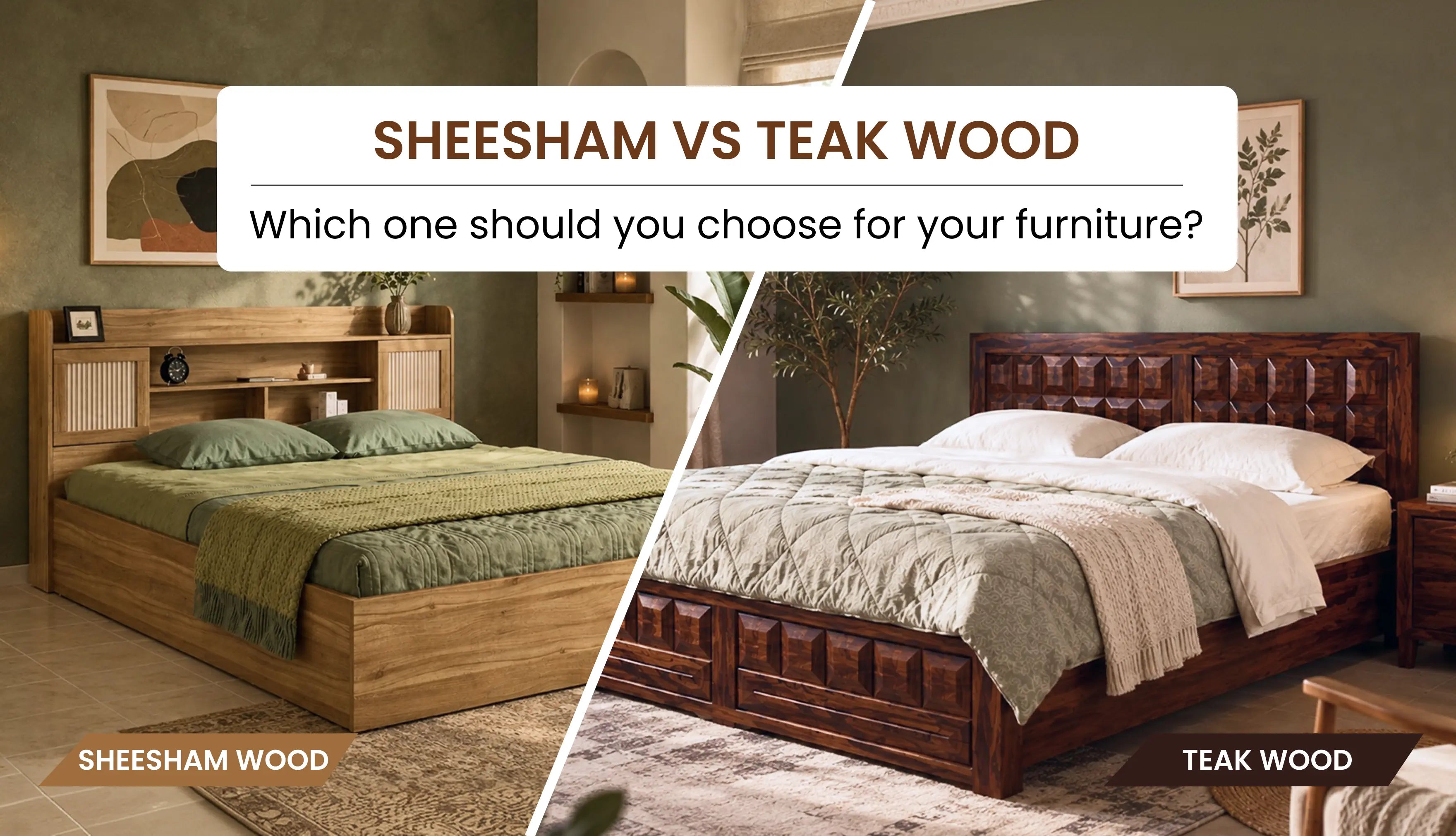
Short answer, if durability and moisture resistance are what you're chasing, teak usually wins. If you want solid wood without the premium price tag, Sheesham holds up just fine for most indoor furniture. Budget and location end up deciding this more than personal preference ever does. Humid coastal home? Teak has the edge. Everywhere else, a good-quality Sheesham piece does the job without much fuss.
Sheesham vs Teak Wood - Quick Comparison
| Parameter | Sheesham Wood | Teak Wood |
|---|---|---|
| Appearance | Rich brown tones with a distinct, varied grain pattern | Golden to medium brown with a more even grain |
| Durability | Dense and durable, making it suitable for everyday furniture | Highly durable and known for its long-lasting performance |
| Moisture Resistance | Handles normal indoor conditions well but still needs protection from prolonged moisture | Naturally more resistant to moisture and humidity |
| Maintenance | Needs regular cleaning and occasional care to keep the finish looking good | Relatively easy to maintain once properly finished |
| Weight | Heavy and sturdy | Heavy and sturdy |
| Best For | Beds, dining tables, cabinets and statement furniture | Beds, dining tables, wardrobes and furniture meant for long-term use |
| Look & Feel | More noticeable grain gives each piece a slightly different character | Classic, warm finish that works well across traditional and modern interiors |
| Price | Generally more affordable than premium teak, depending on quality and construction | Usually more expensive, especially when using high-quality genuine teak |
| Best Choice If... | You want natural wood with a distinctive grain and good durability | You want maximum durability and better resistance to moisture |
What is Sheesham Wood?
Also called Indian Rosewood or Shisham, and it's everywhere in Indian homes, dining tables, beds, cabinets, chairs, coffee tables. People fall for the grain first. Darker streaks, natural variation, nothing looks too uniform. Cut two tables from the same log and they still won't match exactly.
It's easier on the wallet than teak too, which explains a lot of its popularity among people who want real solid wood without stepping into premium territory. One catch worth remembering: it needs proper seasoning before it's turned into furniture. Skip that step and humidity swings can crack or warp it down the line.
What is Teak Wood?
Known across India as Sagwan, teak is a premium hardwood, warm golden-brown, naturally oily to the touch. Those oils aren't just for looks. They're the reason teak fights off moisture and insects better than most woods you'll find on a showroom floor. It's been a furniture staple for generations too. A well-made teak bed or dining table can sit in a home for years and never once look out of place, even as everything around it changes.
The catch, and it's a real one, good teak isn't cheap. It earns its reputation for durability and moisture resistance, sure, but whether that's worth paying for comes down to how much those two things actually matter to you.
Sheesham Wood vs Teak Wood: Key Differences
Appearance & Grain
Sheesham's for anyone who wants wood that shows some personality, dark streaks, visible variation, a look that shifts piece to piece. Teak plays it calmer, golden to medium brown, understated, deepening slightly with age. Want the grain to be part of the design statement? Sheesham. Prefer something cleaner and more uniform? Teak.
Durability & Strength
Both count as proper hardwoods, which is exactly why so much daily-use furniture gets built from one or the other. A well-built Sheesham bed handles years without protest, same goes for a dining table pulling double duty through rushed breakfasts and a full house at lunch. Teak still edges ahead long-term, its natural oils help it ride out humidity swings better. But construction beats labelling every time. A solid Sheesham piece will outlast badly made teak furniture, no contest.
Termite & Moisture Resistance
Probably the biggest difference worth actually thinking about, especially here in India. Teak's oils give it real resistance to moisture, insects, and decay, which is why it's been the go-to in damp conditions for generations. Sheesham has some natural pest resistance of its own, but it leans hard on how well it's been seasoned and finished. Location changes everything here. Someone in Mumbai or Kochi is fighting a completely different battle than someone living somewhere dry, especially once the monsoon settles in for a few months straight. Teak buys peace of mind in those conditions. Sheesham can still hold its own indoors, it just needs more attention paid to ventilation and moisture, particularly if the bed's up against a damp wall or the dining table's parked near an open balcony.
Maintenance & Workability
Neither wood looks after itself. Both need to stay reasonably dry, cleaned with the right products, nothing dramatic. Sheesham is easy to work with, which is exactly why it shows up so often in furniture with detailed carving and visible grain. Depending on the finish, it might need occasional polishing. Teak's workable too, though its natural oils can mess with certain finishes and adhesives during construction. For everyday care, the rule is simple enough: wipe spills instead of letting water sit, keep the piece away from constant dampness, and stick to whatever care instructions came in the box.
Price & Availability in India
Sheesham wins on price, plain and simple, and that's a big part of its appeal. Teak swings a lot depending on source and quality, premium teak gets expensive fast, while Sheesham keeps solid wood within reach for most budgets. The wood is only one piece of the final price too. Design, construction, hardware, finish, how much timber actually went in, all of it adds up. That's why two pieces made from identical wood can carry wildly different price tags. Furnishing a whole home, going with Sheesham for a few pieces can free up real money for the rest.
Sustainability
Neither wood automatically wins this one. Sheesham grows widely across India, a lot of it through plantations and agroforestry. Teak's grown in plantations too, in several parts of the world. What actually matters is where a specific batch came from and whether it was sourced legally and responsibly. Spending real money on solid wood furniture, it's fair to just ask the seller about sourcing instead of assuming the wood's name tells you the whole story.
Which Wood is Better for India's Climate?
There's no single answer here, India's climate shifts too much region to region, and the same piece can age completely differently depending on where it lives. Coastal cities like Mumbai, Chennai, or Kochi, teak is usually the safer call, its natural oils just handle sustained humidity better. Sheesham can still hold up fine in these homes though, provided it's properly seasoned and finished, with decent ventilation doing the rest. Keep it in an air-conditioned bedroom away from direct moisture and the gap often stops mattering much at all.
Drier parts of the country, Sheesham pulls further ahead as the practical choice, giving you that solid wood look and feel without paying what good teak demands. The room matters more than the general climate anyway. A teak table might make sense on a humid balcony. A Sheesham bed in a well-ventilated bedroom does just fine.
Sheesham or Teak - Which One as Per Vastu?
Both woods are generally considered fine for furniture under Vastu traditions, no universal rule crowns one as the only correct pick. Teak often gets tied to strength and stability, while Sheesham shows up just as often in Vastu-following homes. If Vastu genuinely matters to you, placement probably deserves more attention than wood type, where the bed or table actually sits tends to carry more weight than what it's made from. Worth remembering Vastu is a traditional belief system, not a scientific measure of wood properties, so weigh it alongside the practical stuff too, quality, budget, climate.
Sheesham Wood vs Teak Wood by Furniture Type
Beds lean Sheesham if you want solid wood without overspending, teak if you're after a premium piece meant to last generations. Dining tables work fine either way, Sheesham for everyday family use, teak for something a notch more premium. Wardrobes manage well in Sheesham when properly finished, though teak makes more sense if humidity's a genuine concern in that room.
Sofa frames rarely justify the extra spend on teak unless moisture's actually a factor, a good Sheesham frame already brings plenty of strength for daily use. Study tables suit Sheesham if you like a visible grain, teak if you want premium and don't mind paying for it. Outdoor furniture is really where teak makes its strongest case, its resistance to moisture and decay simply outperforms Sheesham once it's exposed to the elements.
Price Comparison: Sheesham vs Teak Wood (2026)
Sheesham generally costs less, though there's no single fixed number across India, timber quality, source, seasoning, and availability all shift things around. As a rough guide, seasoned Sheesham tends to sit below plantation teak, while premium teak can climb a lot higher. Keep in mind these are raw timber prices, not what you'll actually pay for a finished bed, dining table, or wardrobe.
Once wood becomes furniture, you're paying for design, joinery, polish, hardware, and labour too, which is exactly why two pieces made from the same wood can land at very different price points. A tighter budget usually stretches further with Sheesham, leaving room to spend elsewhere in the house. Comfortable paying more for durability and moisture resistance, teak becomes a reasonable bet.
Our Recommendation: Which Should You Choose?
For most indoor furniture, Sheesham is the more practical pick if solid wood at a fair price is the goal. It looks good, holds up well, and works especially nicely for beds, dining tables, and cabinets. Teak becomes the better call once durability and moisture resistance start mattering more than price, especially somewhere humid and coastal, or for furniture you plan on keeping for decades.
Either way, don't decide on the wood's name alone. Ask about seasoning, construction, and finishing too. A well-made Sheesham piece can genuinely outlast badly built teak furniture.
FAQs
Is sheesham wood good for beds?
Yes. It's strong enough for everyday bed frames, just make sure it's properly seasoned and well constructed.
Which is better, sheesham or teak, for dining tables?
Both work. Sheesham suits a tighter budget, teak suits someone after a premium table with better moisture resistance.
What are the disadvantages of sheesham wood?
It can react to humidity if not properly seasoned, and tends to need more upkeep over time than teak, especially somewhere very humid.
Is sheesham wood termite-resistant?
It has some natural resistance, though it's not fully termite-proof. Proper treatment and keeping it away from prolonged moisture still matter.
Which wood is better for humid climates - sheesham or teak?
Teak, generally, thanks to its natural oils. Properly seasoned Sheesham can still work indoors, it just asks for more attention.
Sheesham vs teak: which is more Vastu-compliant?
Both are commonly considered suitable under Vastu traditions, no universal rule favours one over the other. Placement and direction usually matter more than the wood itself.


